
He’s From Mars, She’s From Venus — Your Texts Are From Neither
Here is the strangest thing about modern dating: two people can be crazy about each other and still spend a Tuesday night staring at the same six-letter text, reading two completely different messages into it. He sends “sounds good” and means sounds good. She receives “sounds good” and hears a door quietly closing. She sends a single thumbs-up because she’s mid-meeting; he receives it and starts drafting his own emotional obituary.
The old joke says men are from Mars and women are from Venus. Texting, though, comes from a third planet entirely — one with no tone of voice, no facial expressions, no timing cues, and a read receipt that tells you when someone saw your message but nothing about what they felt while reading it. Most texting anxiety isn’t about the words. It’s about the silence around the words, which our brains helpfully fill with the worst available interpretation.
So let’s translate. Here are the five messages everyone misreads, what people fear they mean, and what they usually mean in real life.
1. The One-Word Reply
What you fear it means: “I’m losing interest. This is the beginning of the slow fade.”
What it usually means: “I’m busy, distracted, or genuinely have nothing to add — and I trust you enough not to perform enthusiasm.”
Short replies correlate with context far more than with affection. People answer briefly when they’re at work, driving, cooking, or talking to someone in the room. Interestingly, very short texts are also a sign of comfort: early on, most of us write little essays to impress. The person who replies “nice” to your photo may simply feel secure enough to be brief.
The fair test: Look at the pattern across a whole day, not a single message. Is the shortness new, or is it just Tuesday? And when you ask a real question, does a real answer show up? Judge the river, not one cup of water.
2. The Delayed Reply
What you fear it means: “They saw it. They chose not to answer. I ranked below everything else in their life.”
What it usually means: “My phone was in another room, my battery died, or I opened it at a red light and meant to answer later.”
This is the most misread signal in all of dating, because the read receipt turns a mundane gap into what feels like evidence. But a delay is a fact about someone’s afternoon, not a verdict on your worth. People with jobs, kids, commutes, and gym sessions all produce three-hour gaps while being perfectly fond of the person waiting.
The fair test: Reciprocity over time. Do they also initiate? Do conversations resume warmly, or do you have to restart the engine every time? A person can be a slow texter and a serious dater. What matters is whether the interest is mutual across days, not minutes.
3. The Emoji-Only Reply
What you fear it means: “They couldn’t even be bothered to type words. I’ve been downgraded to a reaction.”
What it usually means: “I wanted to acknowledge this right now, and a 😂 or ❤️ was faster than the sentence I didn’t have time to write.”
For many people — especially fluent phone natives — an emoji is a complete sentence. The laughing face on your joke is not a dismissal; it’s applause in shorthand. The heart on your good news is someone saying “I’m here, I saw it, I care” from inside a meeting, a bus, or a grocery line.
The fair test: Emojis that end every conversation for days are different from emojis that bridge between real conversations. The first pattern is low effort. The second is just modern punctuation.
4. The Double Text (Yours)
What you fear it means: “I sent two messages in a row. I look desperate. It’s over.”
What it usually means: Almost nothing — to them. The double text (and its cousins, the triple text and the follow-up meme) is terrifying only to the sender. Research on how we judge our own messages versus how others receive them consistently shows we grade ourselves far more harshly than anyone else does. The person on the other end typically registers “oh, two messages” and reads them in order.
The fair test: One follow-up is human. A pattern of escalating follow-ups to unanswered messages — five, six, seven texts chasing silence — is different, and it’s not really about texting etiquette. It’s information: the other person’s interest doesn’t match yours, and no formatting strategy fixes that. Send the second text without shame. Just don’t send the seventh.
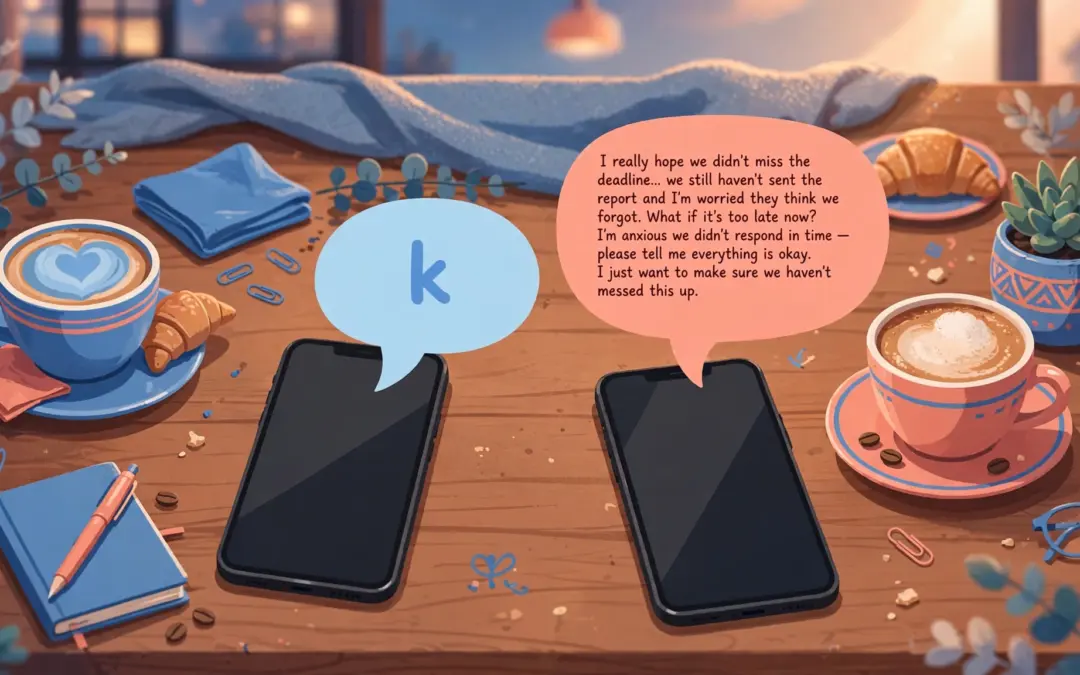
5. The “K”
What you fear it means: Coldness. Annoyance. Possibly the single most hostile letter in the alphabet.
What it usually means: “Okay.” Just… okay. Often typed one-handed, often by someone who texts their own mother the same way.
Of all the entries on this list, “k” has the worst reputation relative to its actual intent. Yes, in some friend groups “k” is a known sarcasm delivery device — context your dating life may not share. Most adults who type “k” are confirming a plan, not ending a relationship. If “k” arrives after “see you at 7,” it’s logistics, not frostbite.
The fair test: Tone lives in clusters. “k” plus shorter replies plus cancelled plans plus no initiation — that’s a pattern worth believing. A lone “k” on a Wednesday is a person holding a coffee in their other hand.
Insights: The Translator’s Handbook
A few principles that will save you more anxiety than any decoding chart:
- Texting style is a trait, not a mood. Some people are novelists, some are headline writers. Learn your person’s baseline before reading meaning into deviations.
- Anxiety reads silence as rejection. When you’re nervous, your brain treats missing information as bad information. The gap is neutral; your fear fills it.
- Match energy, not stopwatch times. Reply roughly at the warmth level you receive. Don’t perform delays to seem busy — people can smell strategy, and it isn’t attractive.
- Escalate the medium, not the worry. If a text thread keeps confusing you, that’s the signal to call or meet. Voice carries everything text leaves out.
- Ask once, kindly. “Hey, are we good?” asked calmly has ended more spirals than any amount of screenshot analysis with friends.
The text is rarely the message. The pattern is the message.
The Real Translation
Here’s the part nobody wants to hear, from either planet: you cannot decode your way into certainty about another person. What you can do is stop treating single messages as verdicts, watch patterns instead of moments, and remember that the person you’re texting is also a busy, distracted, phone-in-another-room human — probably reading your perfectly normal “sounds good” right now and wondering what it means.
If the misread texts are piling up because you’re still in the early, guessing phase, spend less time analyzing and more time actually getting to know people — our matchmaking section exists for exactly that. And when you need a lighter way to learn how someone thinks, the games and tools here are a lot more fun than rereading a chat thread at 1 a.m.
Mars, Venus, or the third planet of texting — the couples who make it aren’t the ones who never misread a message. They’re the ones who give each other the benefit of the doubt, one “k” at a time. For more everyday translation help, browse our dating advice section — and may all your delayed replies just mean a dead battery.